Tuesday, April 23, 2013

A Global Steel Industry

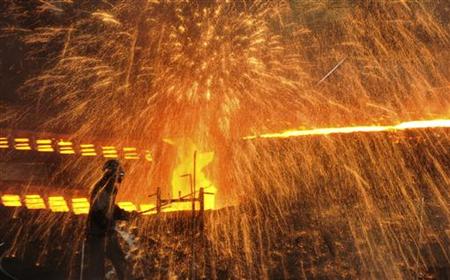
The once simple steel industry that Carnegie dominated in the late 1800’s is a much different one today. Steel is not produced mostly in the United States like it was back then, and is a much more global market. Here are the top steel distributors in the world, and how things are looking for them at the moment.

3. United States

The United States produced 88.6 million tonnes of steel in 2012, which put it third on the list for steel production. The United States is nowhere close to being the king of steel like it was a few decades ago, and it probably won’t reclaim its throne for quite some time. Steel production in 2009 was a rough year, but production has picked back up thanks to the help of governmental projects and a resurging economy. Many steel producers in the United States like Capital Steel & Wire compete with steel giants abroad by producing higher quality and more reliable steel at higher prices. With India right behind the United States in production, it probably won’t be long until the United States ranks fourth in largest steel producers.

2. Japan

Surprising to many is the fact that Japan is the second largest steel producer in the world, producing 107.2 tons in 2012. With some of the largest ship building ports in the world, Japan produces a large percentage of the world’s steel for ships. Additionally, Japan is home to some of the largest car manufacturers in the world, which all require large quantities of steel for production.

1. China

What should come as no surprise is that China is once again at the top of the list for steel production, producing 715.5 million tons in 2012, which was 46% of the entire world’s steel production. This tremendous output of steel is a result of a huge need for steel internally, the ability to make steel in super huge quantities at lower prices, and a large workforce available and willing to provide the human labor. China was one of the few countries that didn't lose a step in 2009, when the entire world steel industry seemed to lose ground, and they don’t seem to show any signs of slowing down.

Wednesday, April 17, 2013

Calling All Entrepreneurs: Why Not a Bowling Alley?

Bowling ball
I've been feeling awfully nostalgic lately about my childhood, and one of my favorite hobbies back in the day was bowling. Birthday parties and Sunday afternoon leagues at the bowling alley were some of my favorite memories. Now that I've moved away from my hometown, the nearest bowling alley is 45 minutes away, which begs the question, why aren't more entrepreneurs moving into this space?

Bowling is a quintessential American hobby, and one that is enjoyed by a huge percentage of the population. The groundbreaking book Bowling Alone by John Putnam even uses bowling leagues as a metaphor for a sense of community and togetherness. It seems to me that more kids are playing Wii bowling today than enjoying fun afternoons at the bowling alley with family and friends.

 Bowling alley franchises are hardly the most difficult investment to make. Top bowling alley equipment companies offer package deals for those starting franchises, and there are many resources for entrepreneurs working to start their own bowling alley.  It seems to me that there are a lot of  places lacking this fun community activity. Instead of trying to break into a market already flooded with fast food establishments, let's bring back this great American pastime. Who's with me?

Thursday, January 24, 2013

Traveling Bangkok

The Temple of the Emerald Buddha, one of the K...

I know you all want to here more about China.  But there’s just more to tell about Bangkok.  I’m sorry!  I promise there will be plenty of posts about China.  Just don’t hit me!  For the time being I am still trying to wrap my head around the fact that I have to actually teach my students how to improve their English.  This is quite difficult for me to do because it is very apparent that I don’t know the first thing about teaching.  I’m and engineer for goodness sake!  I should be dealing with calculus and physics, not with getting people to talk back to me in my native language.

Anyway, there will be plenty more of that later.  I will be here for a while, so there will be time, I swear.  Now, back to Bangkok!

Where I left off, we had been touring Chatuchak, a market simply mammoth in proportions.  You could find almost anything imaginable for sale there.  From clothes, to furniture, to trinkets, to weapons, to animals (see part 1), all the way to the really bizarre and totally repulsive:

A quick snack anyone? Be thankful there is no such thing as smell-o-vision.

After we finished with the market, we decided to call it a day.  It was getting late in the day and we were all exhausted from sight-seeing.  That night we went to supposedly the best night club in Bangkok.  To say the least, I was not impressed.  At the beginning of the night the place was filled with middle-aged men and a smattering of young girls. There was an odd smell in the place due to so many people being crammed into a small space and poor ventilation.  If you have been to pretty much any night club in New York City, you probably know what I’m talking about.  The entire night there was very loud and very terrible house/techno music being played.  It was so loud that I nearly lost my voice trying to talk to my friends, who were standing right next to me.

I’ll take a dive bar with not many people and good music at a reasonable level over a night club any day.
The next day we had a late start due to (ahem) reasons completely and utterly unrelated to the fact that we were out late drinking the night before.  Seriously, nothing to do with it.  Nothing at all.

My friend Mike (whom I had been travelling with, if you hadn’t caught that already) had his two cousins visiting with him while he was in Bangkok.  They were leaving that afternoon, so we head over to the Conrad Hilton where Mike’s mom was staying for a bit of a swim and goodbyes.  After a while I decided to head off on my own to see some more sites before leaving myself the next day.

Thankfully I managed to make it over to the Temple of the Dawn, which is just incredible.  At somewhere between 66 and 86 meters tall, it was quite a strain just to get up to the highest level (about 2/3 of the way up).  I was definitely sucking wind pretty hard after climbing up the incredibly steep steps.  But once up there, the views are just awesome.  It is definitely one of those really special places that you just need to go to and experience for yourself.  If you ever have the opportunity and good fortune to go to Bangkok, I highly recommend this temple.  Simply awesome.

After the Temple of the Dawn, I met up with a friend at the Grand Palace where we proceeded to wander around. Anyone you met that was trying to help you translate things for money was of no use, and we might have been been getting Arabic translation services. You feel like you need  After a hilarious bout of haggling with a taxi driver (of which there are many), we took a quick ride down to the Temple of the Reclining Buddha to see one of the largest single Buddha images in the world.  Just like everything else I had seen in Bangkok, it was just awesome.  The Buddha is barely contained within the temple, it is nearly impossible to get it all in one picture from inside the building.  It only works to add to the immense size and grandeur of the gold-plated masterpiece.

From there we proceeded to wander around the temple and the surrounding area.  You know how there are certain places in the world where the sunrises and sunsets are just simply incredible?  Like in the desert, seeing the sunset is such a beautiful sight that it is moving.  Well let me tell you, Thailand is one of those places where the sunsets are like that.  All of the temples and statues and edifices are so beautifully decorated and it all glows in the light of the setting sun.

A reflection of the sunset outside the Temple of the Reclining Buddha

That night Mike and I walked through the park to find the statue of one of the Kings of Thailand (I can’t remember which one at the moment).  The park was very big and right near the hotel where we were staying, so I thought it would be a fun little adventure.  Adventure time, hooray!  Anyway, on the way through the park, we discovered a concert where an orchestra was playing music selections from The King and I.  There was a huge crowd sitting on the grass around the stage, so we decided to linger and watch the show.  It was very relaxing and enjoyable.  After the past four days of the hustle and bustle of Bangkok, it was really nice to just sit on the grass and enjoy the sounds and the scenery.

After we found the statue, we went to dinner.  The I left for the airport to catch my plane to come to China.  And here I am!

Thursday, November 15, 2012

Video Marketing


Viral marketing (and advertising) is an effective method to use on social networks to raise awareness. Understanding the important role that marketing plays a video promoting your business online is a huge difference in the success of your marketing.

The theory of viral marketing is easy if you have a compelling, true story, a friend tells a friend "says a friend who says, my friend, and so on. Also known as "Word of Mouth Marketing," is this unique form of marketing to people's lives are talking together about your services and products. Viral marketing or reputation of the Internet. With the influx of [good and bad] information on the Internet, whether requested or not, your story is to draw attention to your audience and proved to be true and support ethical practices on the Internet.

The behavioral characteristics of Word of Mouth Marketing, can go two ways. A satisfied customer tells an average of three people about a product, service or experience they had while a customer who is unhappy talks to about a dozen. Viral Marketing and Word of Mouth Marketing is the foundation of social networks, networks of people interacting with other people's social activities, for there is an inherent exchange of information, services and ideas.
 
Viral Marketing Video

Between the competitiveness of Internet marketing and the popularity of social networks, marketers were forced to use video. Words can convey the message, but a professional, compelling video is worth a thousand words.

A study published in May 2008 showed that U.S. Internet users viewed 11.5 billion online videos in February-March 2008.

In the same study, Google sites in the reconstruction of the top U.S. video-house, which is more than 4.3 billion videos viewed (38 percent of all videos), share profits by 2.6 percentage points compared with the previous month. YouTube.com account for 98 percent of all videos viewed on Google sites. Fox Interactive Media, second with 477 one million videos (4.2 percent), followed by Yahoo! Pages with EUR 328 million (2.9 percent) and Viacom Digital with 249 million (2.2 percent).

Video marketing has been very adaptable to today, s-line marketing techniques, from traditional video advertising marketplace [advertising], interactive Flash (SWF or FLA) messages online learning (e-learning) is a fire-able software, and send messages to mobile phones, devices , video is a composition useful to bring a lot mediated Resuscitation Mask enthusiasm can be high and social networking potential.

Online video advertising is clearly the best way to display a message to one million people with a simple click of the mouse. As bandwidth and Internet access are bigger, faster and Online Video Broadcasting will soon be the first and most important communication tool. The increased popularity of Internet marketing will also bring about new jobs. The amount of data that can be complied just for one online marketing video is endless. Have a MS in Business Analytics will be very beneficial if you want to study how well certain Internet ads work and don't work.

Tuesday, July 3, 2012

Logistic Upgrades = Productivity Upgrades

Pallets
Pallets (Photo credit: smysnbrg)
Farmland Dairies: Robot Palletizing System

Wallington, New Jersey is home to Farmland Dairies, a milk and ice cream packaging plant. Their facility requires a system that can handle heavy products at high speeds and keep production running smoothly.

Farmland aimed to increase productivity, reduce overhead, and improve product handling. They wanted a system that met their needs and allowed them to save on manpower. To remedy the situation, three palletizing robots, a pallet de-stacker, a pallet feed system, a pallet removal system, and six product supply lines were installed. Developers ran off the system at their facility prior to the onsite installation so Farmland could make necessary adjustments to the design.This new system allowed productivity to increase by 60 percent. 

When thinking about a favorite product or retailer, thoughts might drift to just how many products they package, ship, and sort on a daily basis. For some operations, an efficient conveyor system is everything and can make or break a business.

CaféPress.com: Distribution Center Upgrades

CafePress.com is a popular online retailer that sells clothing and accessories while allowing users to create their own custom merchandise to buy and sell. They were interested in a two-phase process to update their distribution center and make it more efficient.

Café Press needed a system that addressed product flow paths and underutilized facility space. They also wanted to increase capacity by more effectively using vertical space. The solution came in two phases.In phase one, two sortation systems were installed, and so was a direct line from the packing and quality check area to the shipping area. New software also was introduced. In phase two, a mezzanine with ventilation system, sprinklers, lights, data outlets, and power outlets was added. This upgrade allowed for an additional conveyor to be installed.

When complete, product and production flow paths were improved with the new system. In addition, utilization of the product floor was increased. The facility was much more efficient with the added storage space and production capacity.

Tuesday, September 29, 2009

Crisis Management


I read an article a while back in Wall Street Journal (You can its full version here) about the crisis in the U.S. and the reaction of the auto makers. 

The automotive industry has been with a lot of challenges in the recent years, especially with over-capacity of its personnel in the downturn; now and with shadow of financial crisis affecting many industry industries, I can imagine that this problem has intensified...

In such situation, Toyota has adopted a new strategy:
 "Instead of sending the workers home, as the Detroit makers often do, Toyota is keeping them at the plants, though. The employees spend their days in training sessions designed to sharpen their job skills and find better ways to assemble vehicles."

At GM, Ford and Chrysler, workers effectively are paid for not working when their assembly lines are idle, under terms of union contracts. If a plant is shut temporarily, as some were this summer, workers receive most of their pay but don't have to show up. A few attend company-paid classes to learn new assembly skills.

The underlying rationale is simple: We are in a bad situation; we have to cut costs but at the same time can't reduce the workforce so let's do another thing: By organizing workshops and courses to improve operations' performance, we can at least develop our workers' capacity and this is certainly better than paying them without doing anything; also empowered personnel equipped with knowledge can find new ways and alternatives for cost reduction in their activities.

Not bad, right?
Article originally available via Supply Chainer